Your AI Stack Needs a Draft Phase
The mistake isn't which tool you pick. It's skipping the question of which workflow deserves the first pick.
Most AI adoption starts too late in the decision chain.
By the time a team asks “which tool should we use,” they have already skipped the harder question: which workflow deserves the first pick?
The SaaS shopping list problem
The typical AI adoption pattern looks like this: someone on the team attends a conference, reads a newsletter, or watches a product demo. The company subscribes to a chatbot. A copilot gets added to the engineering workflow. Someone automates a report. Three tools get connected to something that already works. A fifth tool gets trialled for a problem the fourth tool didn’t fully solve.
Six months later, the company has eight AI subscriptions, a mix of integrations that occasionally conflict with each other, and a productivity improvement that is hard to attribute to anything specifically. The tools are used inconsistently. The best workflows are in one person’s head. The cost is clear; the compounding value is not.
This is not a tools problem. It is a sequencing problem.
What competitive gaming figured out about sequencing
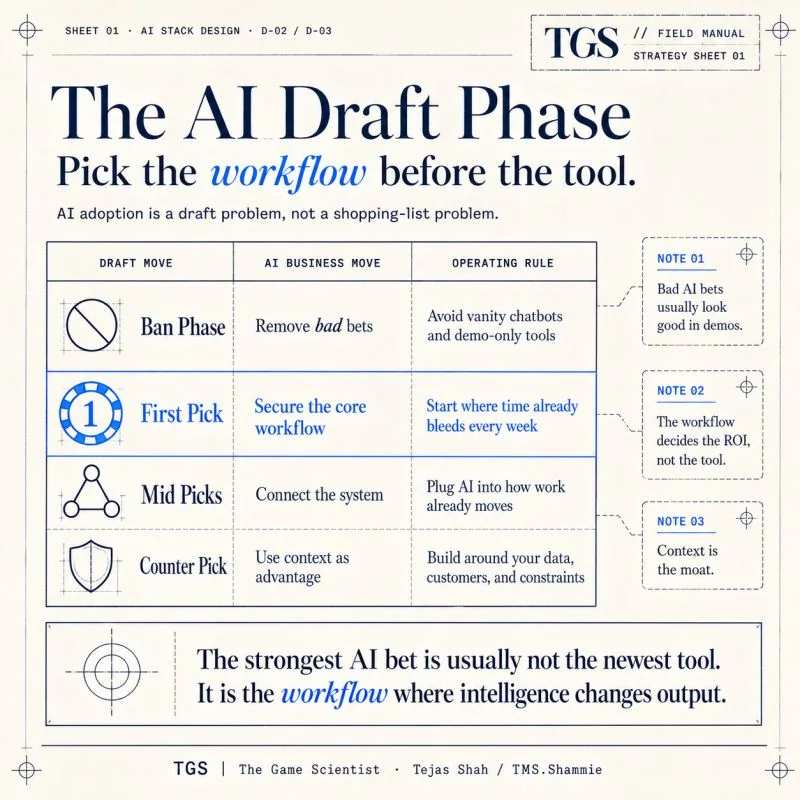
In competitive games like League of Legends, the draft phase is not decoration. Before the match begins, top teams have already decided what to ban, what to protect, and where they want to force an advantage. The draft phase eliminates threats, secures the foundational element, connects the system, and uses counter-picks to exploit the opponent’s revealed structure.
The game is structured before it is played. The team that drafts better has a systematic advantage that compounds through the match — not because they have better mechanics, but because they’re operating inside a coherent framework rather than responding reactively to whatever they encounter.
AI adoption has the same structure. The teams that get the most out of it aren’t the ones who buy the best individual tools. They’re the ones who drafted a stack with deliberate sequencing.
How to run the draft
The ban phase: remove bad bets first.
Before picking anything, filter out the noise. Vanity chatbots that look impressive in a demo but don’t integrate into any real workflow. Generic wrappers around existing models that charge a premium for an interface without adding capability. Tools that solve problems the team doesn’t actually have at any meaningful frequency. The ban phase is underrated because most teams go straight to selection. The wrong tool doesn’t just waste money — it creates adoption debt: people adapting workflows to a tool that will be replaced, which makes the next transition harder.
The first pick: secure the workflow that already bleeds time.
The first AI investment should rarely be the most exciting one. It should be the workflow where better memory, judgment, or execution speed meaningfully changes the output — and where that workflow runs frequently enough that improvement is observable.
In practice, this is usually something unglamorous: a reporting pipeline that takes a senior person four hours a week to maintain. A customer support triage process that requires human judgment for classification but not for response. A QA cycle that runs the same checks on every release. A competitive analysis that needs to happen monthly and currently requires a full day. The first pick doesn’t have to be impressive. It has to be load-bearing.
The mid picks: connect the system.
Intelligence has to plug into how work already moves. If your team lives in BigQuery, the AI that processes data needs to operate at the BigQuery layer. If decisions happen in Slack, the intelligence that surfaces information needs to surface it where those decisions are made. Mid picks that require people to leave their existing workflow to use the tool will generate adoption resistance regardless of how capable they are technically.
This is where most AI stacks fail. The tools work in isolation. They don’t connect to where the work actually happens — or where the decisions actually get made.
The counter pick: use context as your moat.
The strongest AI setups are not always the ones with the most advanced foundation models. They are the ones built around specific business context: your customer understanding, your proprietary data, your team’s documented edge cases, your specific operating rhythm. A mid-tier model with two years of your company’s internal knowledge and your team’s documented processes will outperform a frontier model prompted from scratch every single time.
Context is accumulation. The counter pick is the moment you stop treating AI as a tool layer and start treating it as infrastructure — something that compounds in value the longer you invest in it.
The workflow question
The practical reframe: stop asking “which tool is best” and start asking “which workflow becomes meaningfully better when you add intelligence, memory, and execution speed to it?”
That’s the first-pick question. Everything else — tool selection, integration, model choice, vendor evaluation — flows from the answer.
A team that can answer that question clearly will build a stack that compounds over time. A team that can’t will build a subscription list that looks more impressive on a capabilities slide than it performs in practice.
The ban phase, first pick, mid picks, and counter pick don’t need to happen in a formal meeting. They need to happen in the right order — which most AI adoption currently skips. The question of what deserves the intelligence layer has to come before the question of which tool provides it.
The game is structured before it is played. That sequencing is not a constraint on good strategy — it is what good strategy looks like.