Event Debt: When Live Ops Stops Amplifying and Starts Replacing
Most live games don't collapse suddenly. They accumulate event debt — until a normal Tuesday exposes it.
Most live games do not collapse suddenly. They accumulate Event Debt.
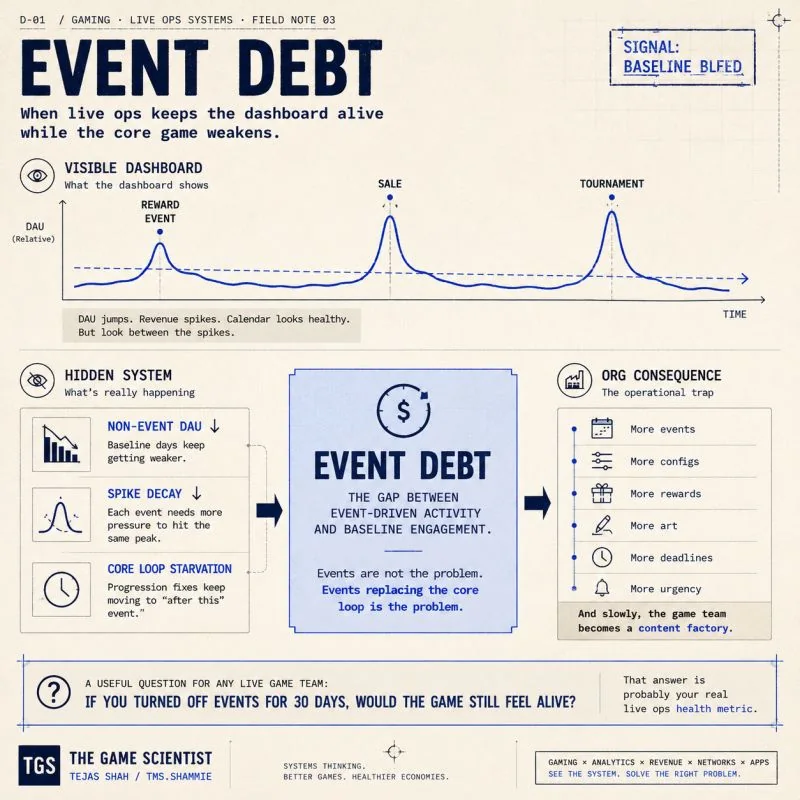
The dashboard can look fine for a surprisingly long time. Events are running. Revenue spikes arrive on schedule. DAU jumps when there is a new reward, sale, collection, tournament, or limited-time objective. The team ships, the numbers move, and the business review looks manageable.
But underneath that, an uncomfortable question is building: what happens on a normal Tuesday?
If players only show up when the reward calendar gives them a reason, the core loop is no longer carrying enough weight on its own. That gap — between event-driven activity and baseline engagement — is Event Debt. It is not visible in most weekly dashboards, and the metrics that would reveal it tend to get rationalized away.
How event debt accumulates
The mechanism is straightforward. A live game’s core loop weakens — sometimes gradually, sometimes after a single botched update — and the operations team responds with more scheduled pressure. More events. More configs. More rewards. More urgency. This works in the short term: the next event covers for the previous month’s retention bleed. The numbers stabilize. The business review moves on.
But the team has now taken on a debt. Every event that papers over a weakening core loop is a bet that the next event will also paper over it. The events aren’t building the game anymore. They’re servicing the debt.
Over time, the game team becomes a content factory. The creative calendar fills. Release cycles compress. The people who were supposed to be designing better progression systems are now managing reward distribution at a frequency that leaves no time for anything else. The work that created the problem — core loop depth, second-session investment, meaningful progression architecture — keeps getting deferred until “after this event.”
Except after this event, there is always another event.
The signals nobody wants to read
Event debt is diagnosable. The signals appear in data that most teams already have but don’t look at in the right combination.
Non-event DAU keeps bleeding. Strip out the event calendar and plot DAU on a baseline. If that line is declining quarter over quarter even as event-day peaks hold, the core game is losing pull. The events are masking it.
Event spikes get flatter over time. The same event type — a sales event, a leaderboard tournament, a reward collection — delivers less uplift at comparable calendar position. Players are responding to the same stimulus with diminishing intensity. This is classic reward schedule saturation.
Rewards need to become more aggressive to hit the same peaks. When the ops team starts increasing reward values to maintain engagement rates, they’re borrowing from future response. Better rewards train players to expect better rewards. The floor for “good enough” keeps rising.
Session quality drops outside event windows. Average session length, depth of progression activity, and social interactions decline between events. Players are still DAU — they’re logging in — but they’re not playing. They’re checking.
Core progression fixes keep getting postponed. This one doesn’t show up in data; it shows up in roadmap conversations. If the team has been talking about fixing the mid-game drop-off or the onboarding loop for three consecutive quarters without shipping it, something is consuming their capacity instead.
The important distinction
Live operations done well amplifies a strong core game. A well-designed sales event on top of a game with genuine player investment captures value that was already building. A seasonal tournament on top of a healthy social graph creates visible stakes for players who already want to compete.
But live operations done badly quietly replaces the core game. The event becomes the reason to return, not the occasion to return. The reward is the engagement, not a recognition of it.
Good live ops and bad live ops can look identical in a weekly dashboard. The difference only becomes visible when you separate the event-driven signal from the baseline signal and watch both trend lines over time.
The diagnostic question
The simplest test for any live game team: if you turned off events for 30 days, would the game still feel alive?
Not profitable. Alive. Would players return, progress, engage, and create their own reasons to come back? Or would the product go silent, revealing that the underlying pull never existed?
That answer is probably your real live ops health metric. The revenue spikes, the DAU peaks, the event response rates — those are operating metrics. The question of whether the game survives without them is the structural metric. Most live game dashboards don’t surface it at all.
What to track instead
A more useful monitoring setup puts event-attributed engagement alongside baseline engagement as separate, persistent metrics — not combined into a single DAU figure:
- Baseline DAU (non-event days): defined strictly, not just days between events but days where no event mechanics are active
- Event response delta: the lift events provide above baseline, trending over time
- Response decay rate: how quickly event response returns to baseline after the event closes
- Core progression velocity: sessions per day that involve meaningful progression activity, not just check-in behavior
If the first three are all declining and the fourth is stagnant, the debt is building faster than the events are servicing it. That’s when the conversation about core loop depth can no longer be deferred.
The LiveOps Event Forecaster on this site models exactly this — the relationship between event intensity and baseline engagement over time. If your event response delta is compressing, the tool will show you how quickly.
Live ops is a powerful tool. The test is whether you’re using it to sharpen a game that already works, or using it to carry one that no longer does.