Every Product Has a Hidden Economy
Most teams design features. They're actually designing exchange rates — whether they know it or not.
Most product teams think they are designing features, layouts, onboarding flows, and interface states.
Realistically, they are designing economies.
The six currencies
A product economy is value moving between the user and the system. The user spends something, the product pays something back, and the transaction determines whether the loop repeats.
The first thing most teams get wrong is assuming the only currency is money. But users spend in six distinct ways:
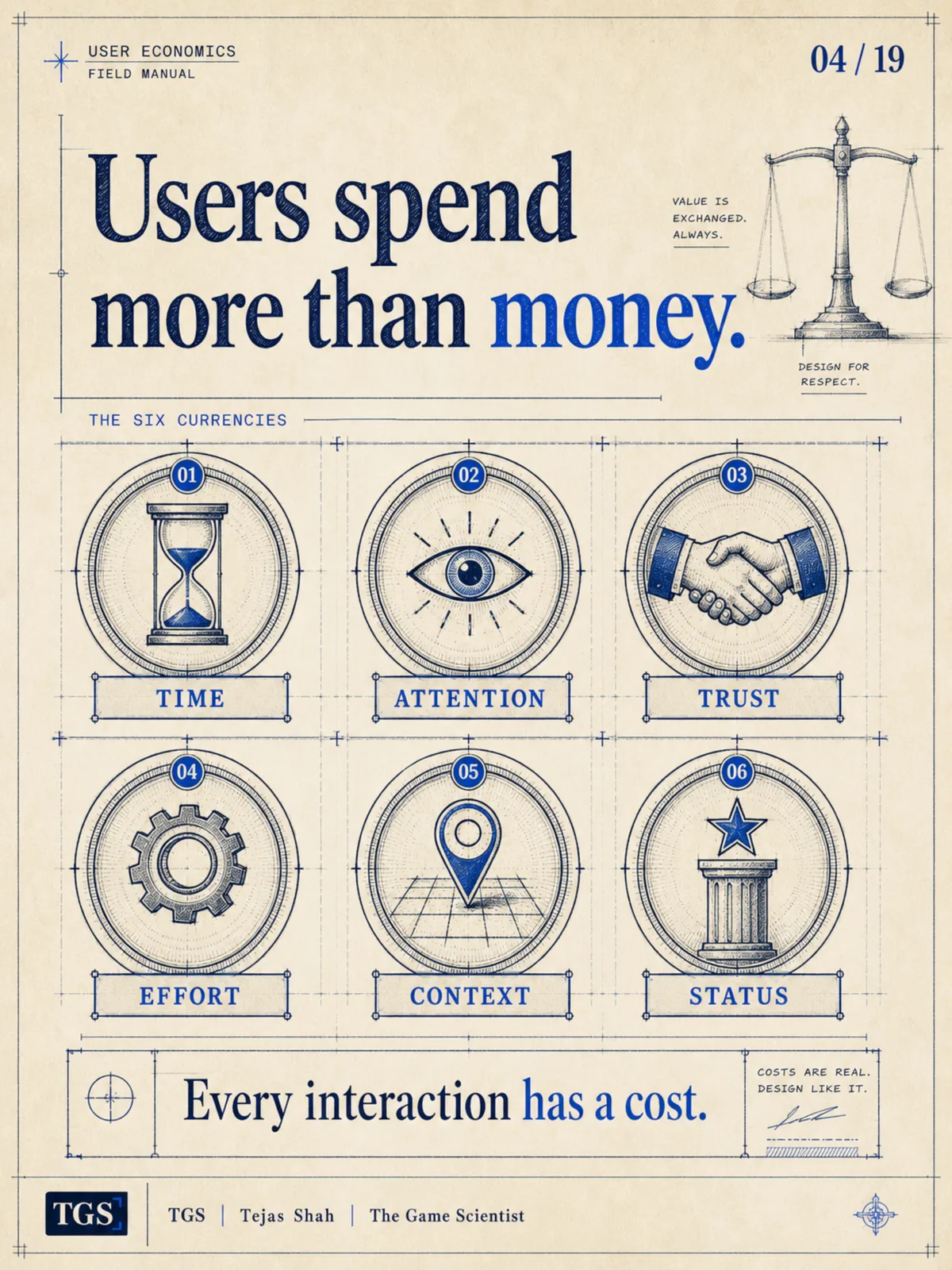
Time — every session is a cost. The question is whether the product returns more value than the time invested.
Attention — focused engagement is finite and non-renewable within a session. Every notification, badge, and alert draws on this account.
Trust — users route work and decisions through systems they believe will handle them well. Trust builds slowly and drains fast.
Effort — setup costs, learning curves, customisation work. Users invest effort expecting that investment to compound into advantage.
Context — proprietary information, personal data, domain knowledge. When a user gives this to a product, they are making a significant and often irreversible bet.
Status — social standing, professional reputation, identity signals. Products that touch these currencies carry unusual weight in the user’s life.
Every interaction is a transaction across some combination of these currencies. Open the app: give it attention, receive something in return. Hand over data: receive more useful output. Invite a colleague: receive more of the social features. Each of these is a trade. Most of them happen without the user consciously registering the cost — until the exchange feels unfair.
What products pay back
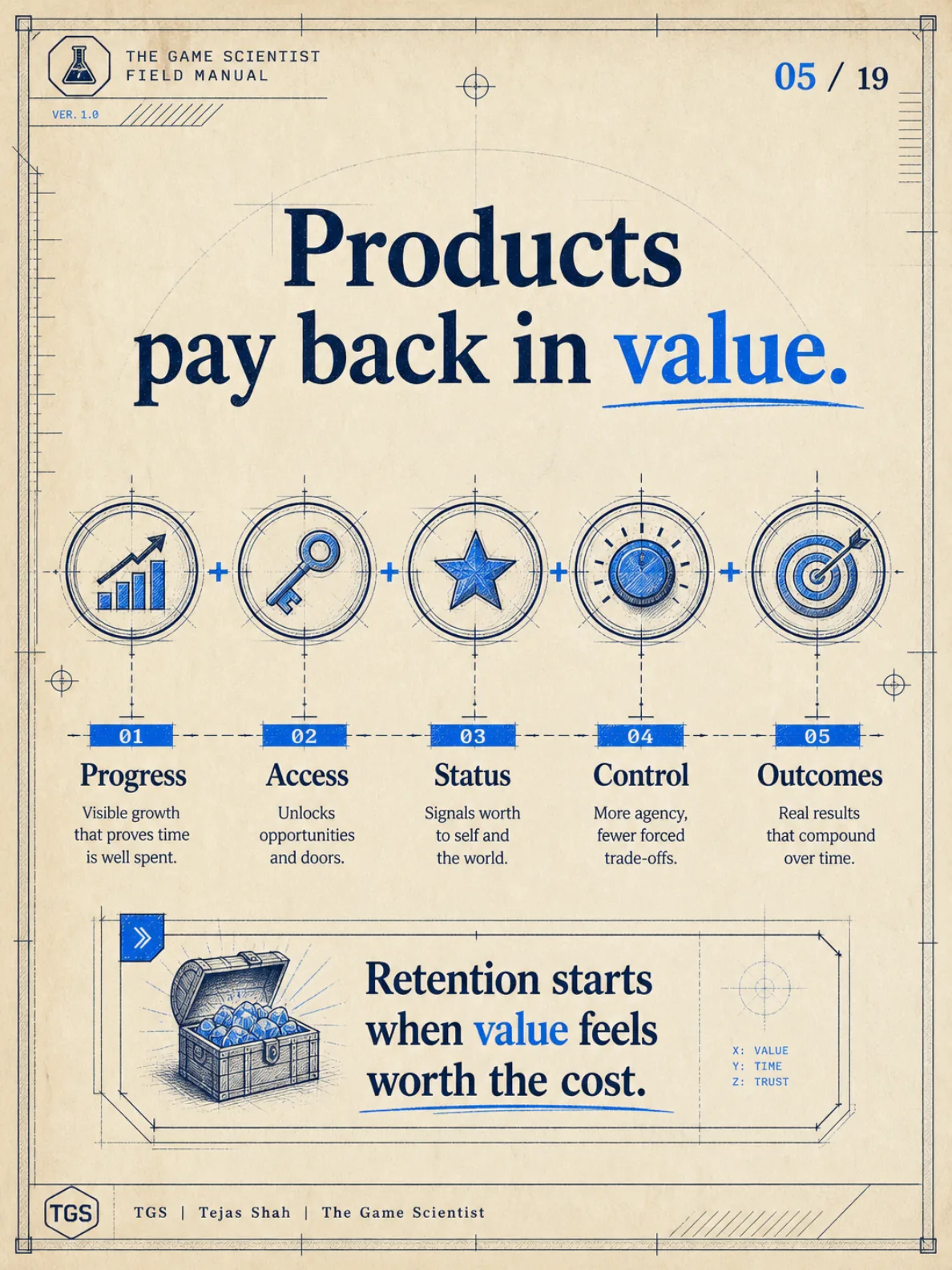
For each currency users spend, a product pays back in one of five return forms: progress (visible growth that proves time was well spent), access (unlocked capabilities and opportunities), status (signals of worth to self and the world), control (more agency, fewer forced trade-offs), and outcomes (real results that compound over time).
Retention starts when value feels worth the cost. When the exchange is positive and compounding — when users invest and receive more than they spent — the loop repeats. When it tips the other way, users leave. Usually without explaining why.
The Product Economy Map
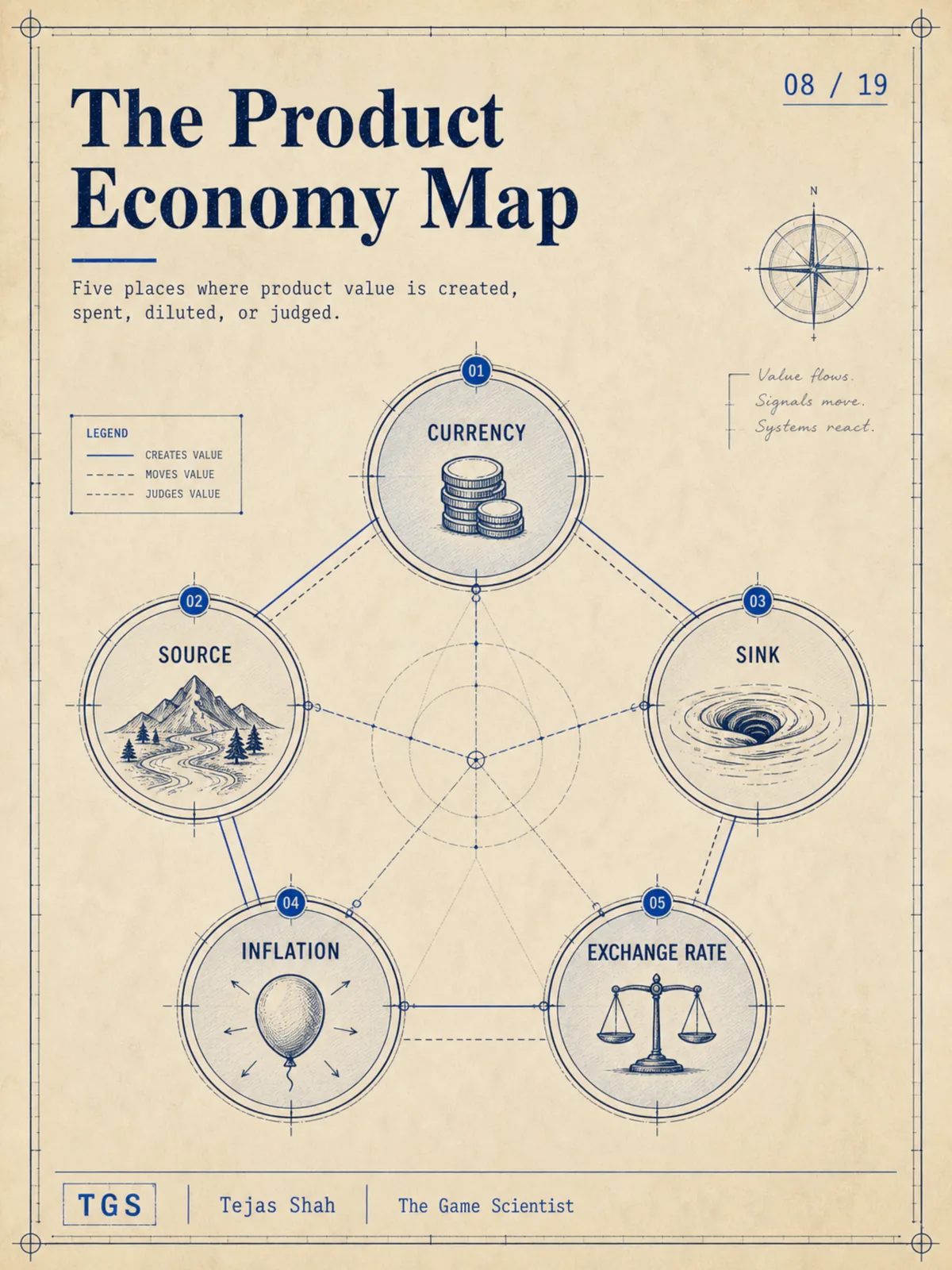
The structure of how value moves through a product follows five nodes.
Currency is the diagnostic starting point: what does the user spend or risk? Which of the six currencies is doing the most work in your product’s economy? Which one is most at risk of being overdrawn?
Source is where value enters the system — through useful output, progress signals, saved time, recognition, or unlocked access. A weak source means there is nothing to distribute. Sources create momentum. A product without a strong source is one where users spend without receiving, and the exchange rate turns negative quickly.
Sink is where value gets reinvested. Users put effort back into the product through projects they build, workflows they configure, upgrades they purchase, preferences they set, and contributions they make. Good sinks create commitment — the more a user has invested in a product’s sinks, the more costly exit becomes. The failure mode here is the investment trap: the product asks for deep sink investment (extensive setup, data import, integration work) without compounding that investment into visible advantage for the user over time. The user has sunk cost but gained no compounding return.
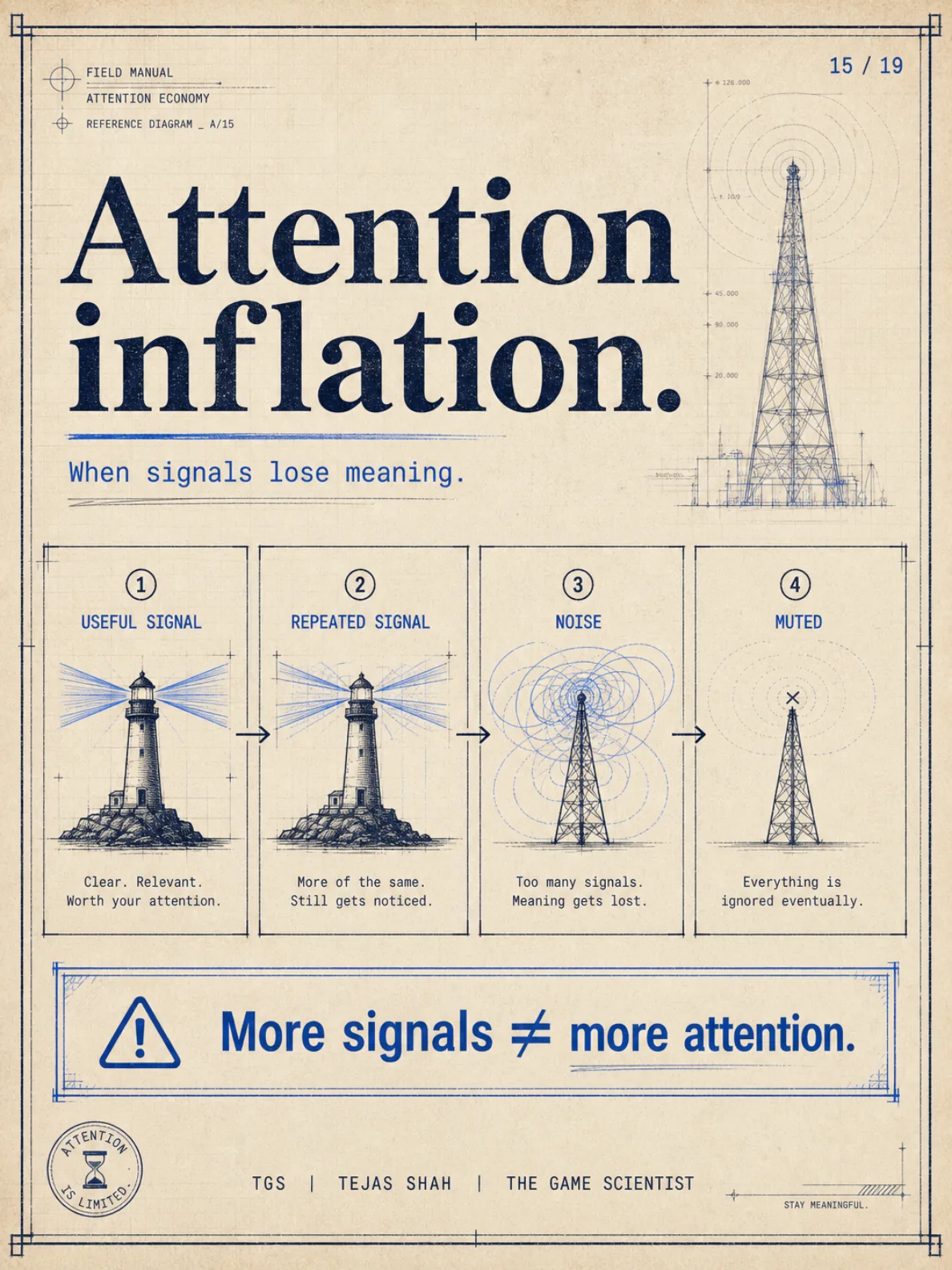
Inflation is where meaning degrades. One strong signal, repeated too many times, becomes noise.
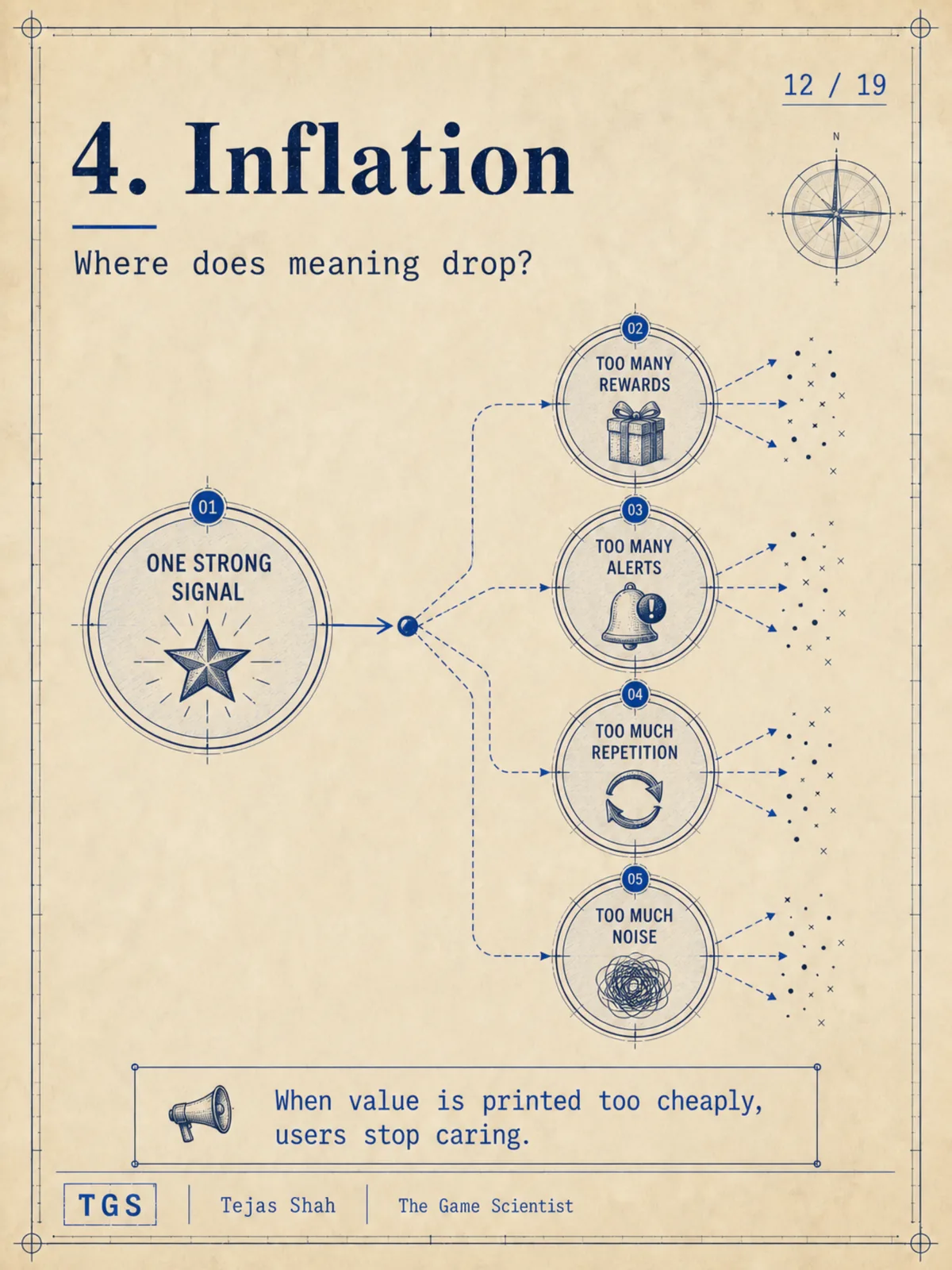 A useful reward, issued too frequently, becomes expected. The decay follows a consistent pattern: useful signal → repeated signal → noise → muted. When value is printed too cheaply, users stop caring. This is attention inflation — and it is why products that over-notify, over-reward, and over-celebrate end up with users who ignore everything they send.
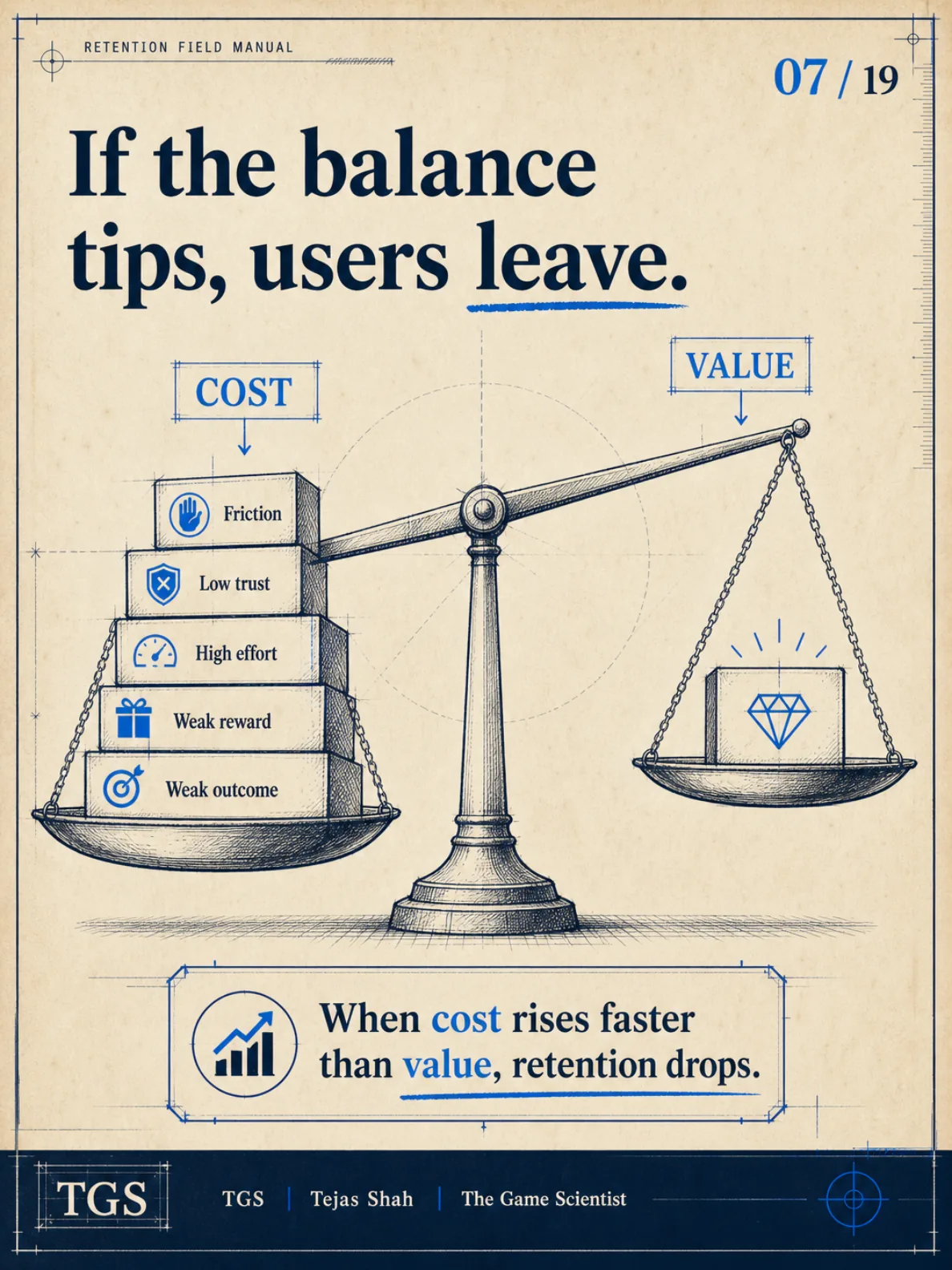
Exchange Rate is the ongoing calculation every user runs, usually unconsciously: is the payout still worth the investment?
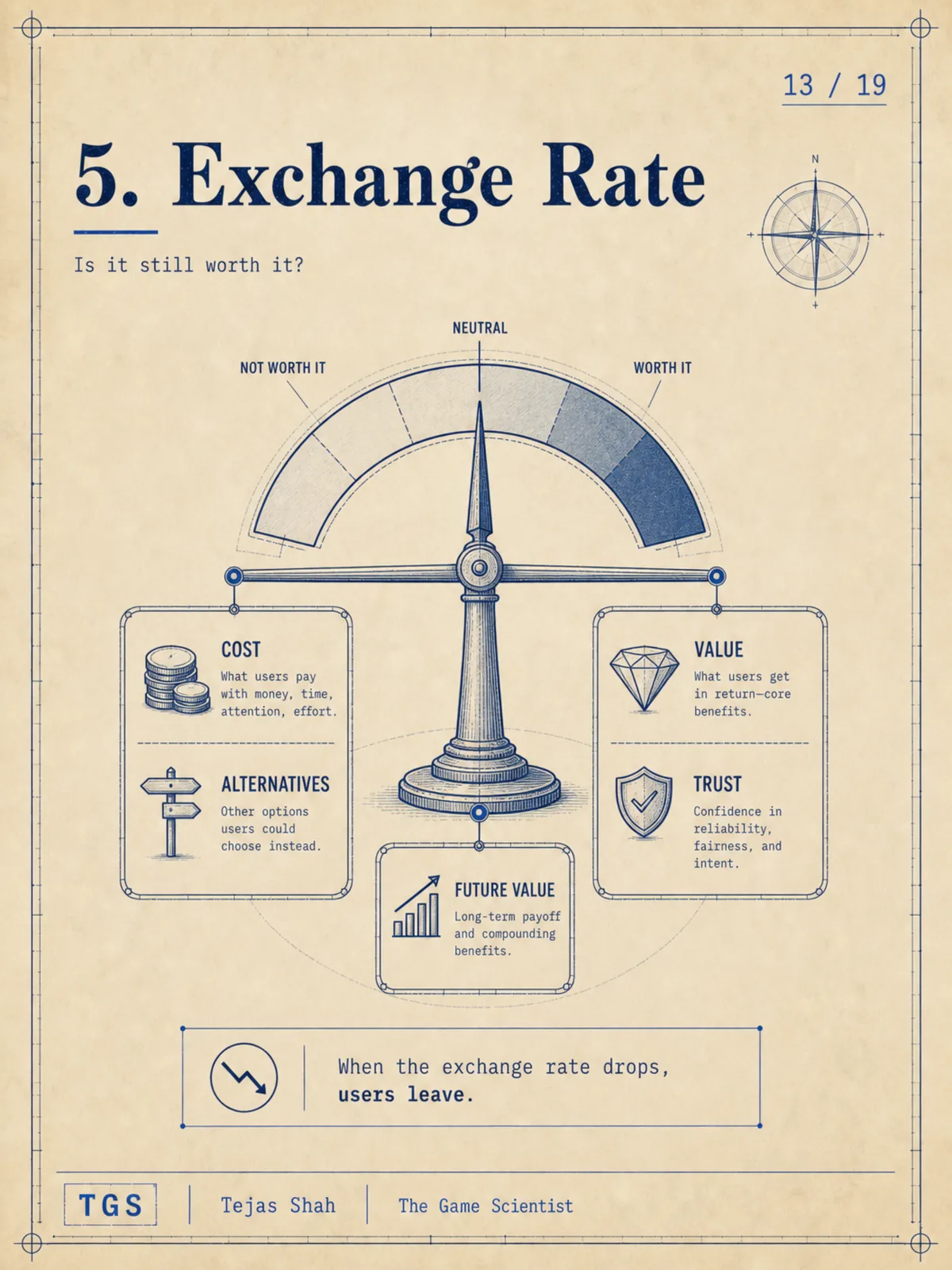 The exchange rate is determined by four factors — cost (money, time, attention, effort spent), value returned (core benefits received), available alternatives (other options users could choose instead), and trust (confidence in the system’s reliability, fairness, and intent). The fifth factor is future value: users are not just evaluating the current transaction, they are estimating whether the exchange will improve or worsen over time. When the exchange rate drops, users leave.
What a broken exchange rate looks like in AI tools
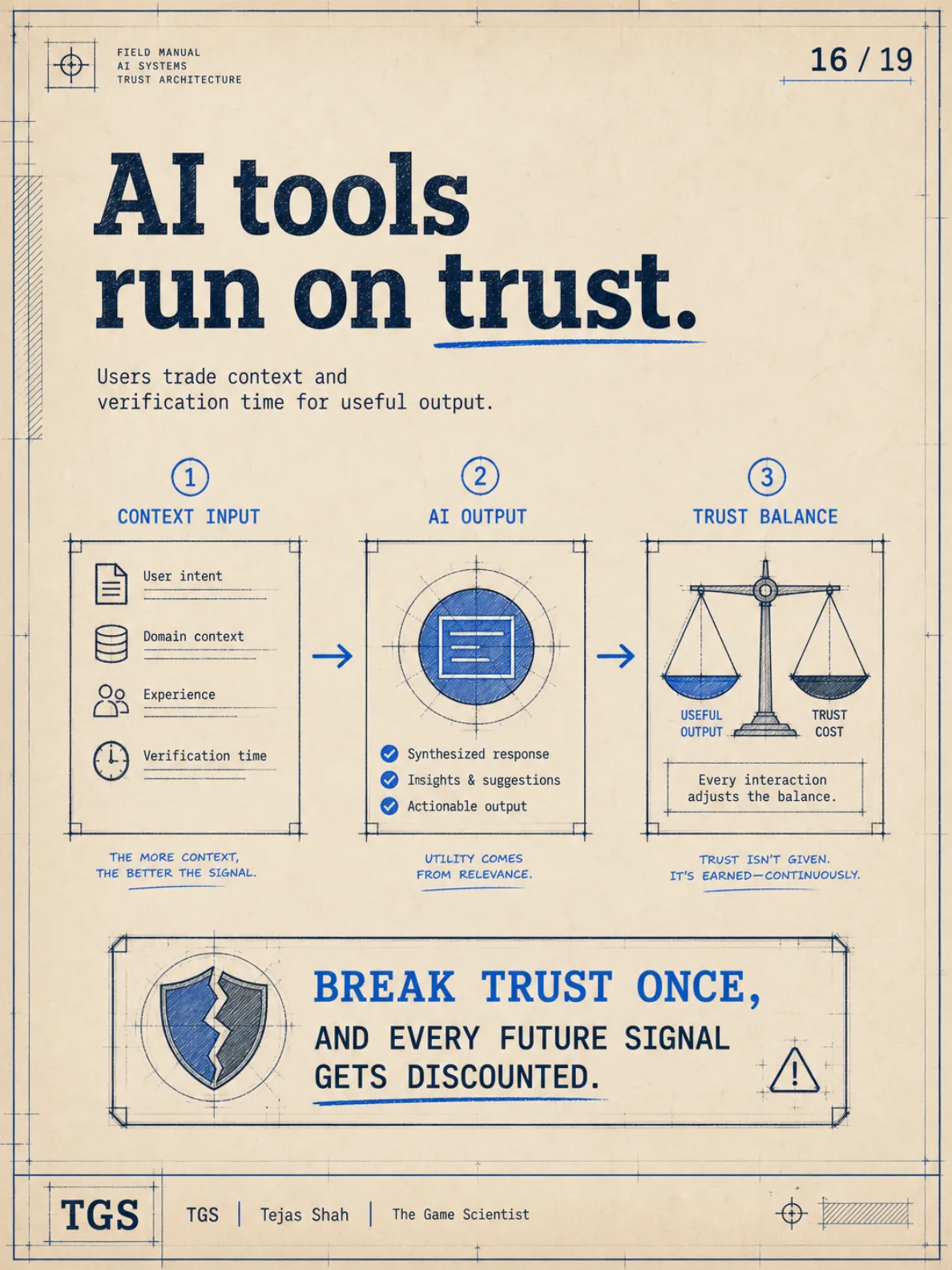
You can see this clearly in professional AI tools. A user is not just paying a subscription. They are spending trust — routing work through an external system that might produce errors. They are spending proprietary context — giving the tool information about their domain, their clients, their methods. They are spending verification time — every output needs to be checked before it goes anywhere meaningful.
If the outputs earn that spend, the exchange improves over time. The trust builds, the context deepens, the user starts structuring more work around the tool because the exchange rate is positive and compounding. Break trust once, though, and every future signal gets discounted. Users who lose confidence in an AI tool do not just use it less. They start quarantining it: routing lower-stakes tasks through it while keeping the work they care about elsewhere, looking for a replacement whenever something credible appears.
The subscription continues. The engagement does not. A churned user who stays subscribed is the slowest and most expensive version of the same problem.
The attention inflation failure in collaboration tools
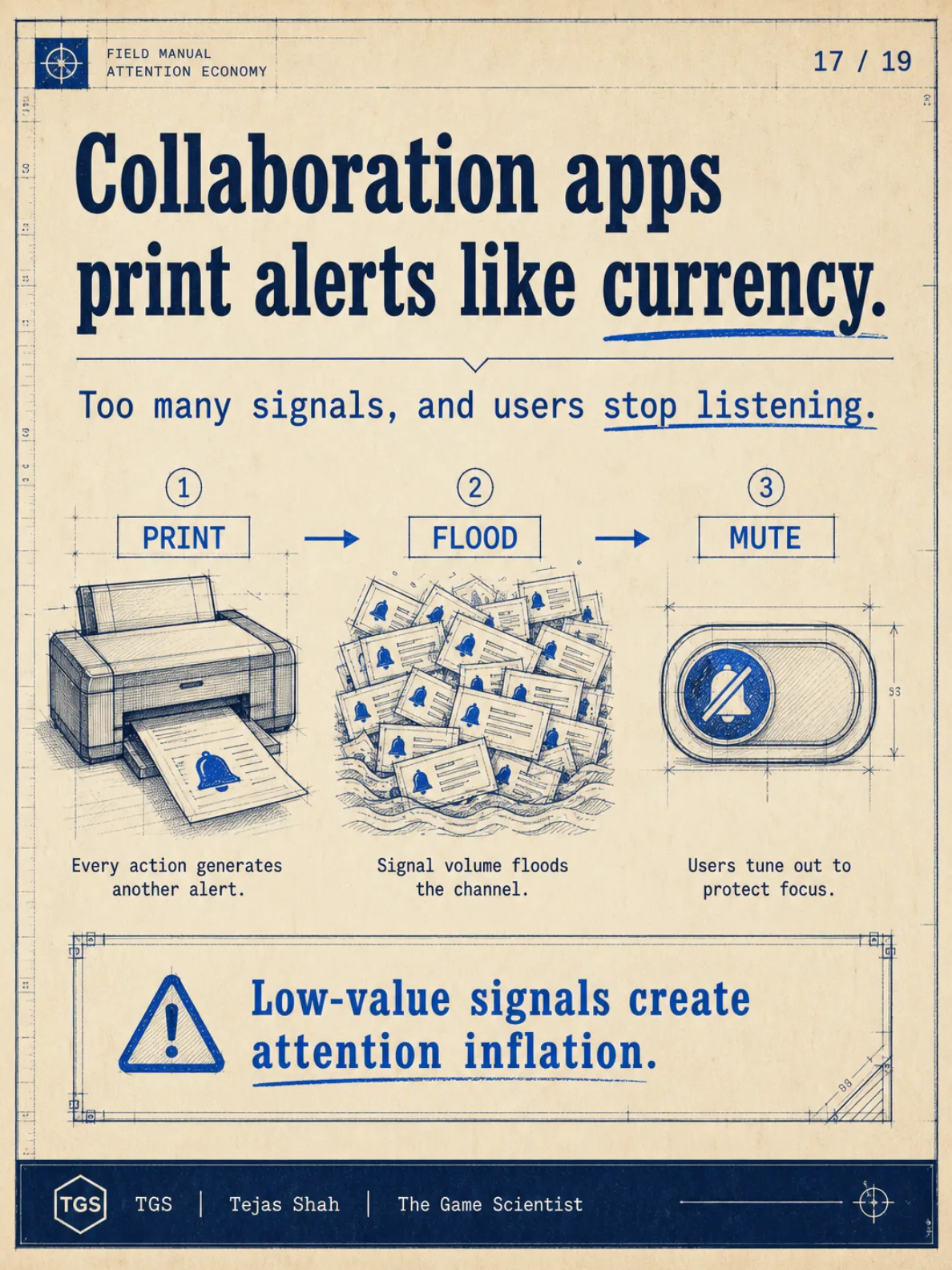
Collaboration tools show the reverse failure with equal clarity.
When every update, badge, summary, comment thread, reminder, and notification asks for attention, the system creates attention inflation. The progression is predictable: one useful notification, then repeated notifications, then noise as meaning gets lost, then muted as users tune out to protect focus. The product is asking for the user’s most limited currency at a rate that exceeds what it is returning in value.
The team’s response is usually to add more features. AI summaries to manage the notification volume. Smarter filtering to reduce the badge count. Better digest formats. Each of these is a correct engineering response to a visible symptom. None of them addresses the underlying problem: the product is spending the user’s attention faster than it is earning it back.
Most fixes attack symptoms
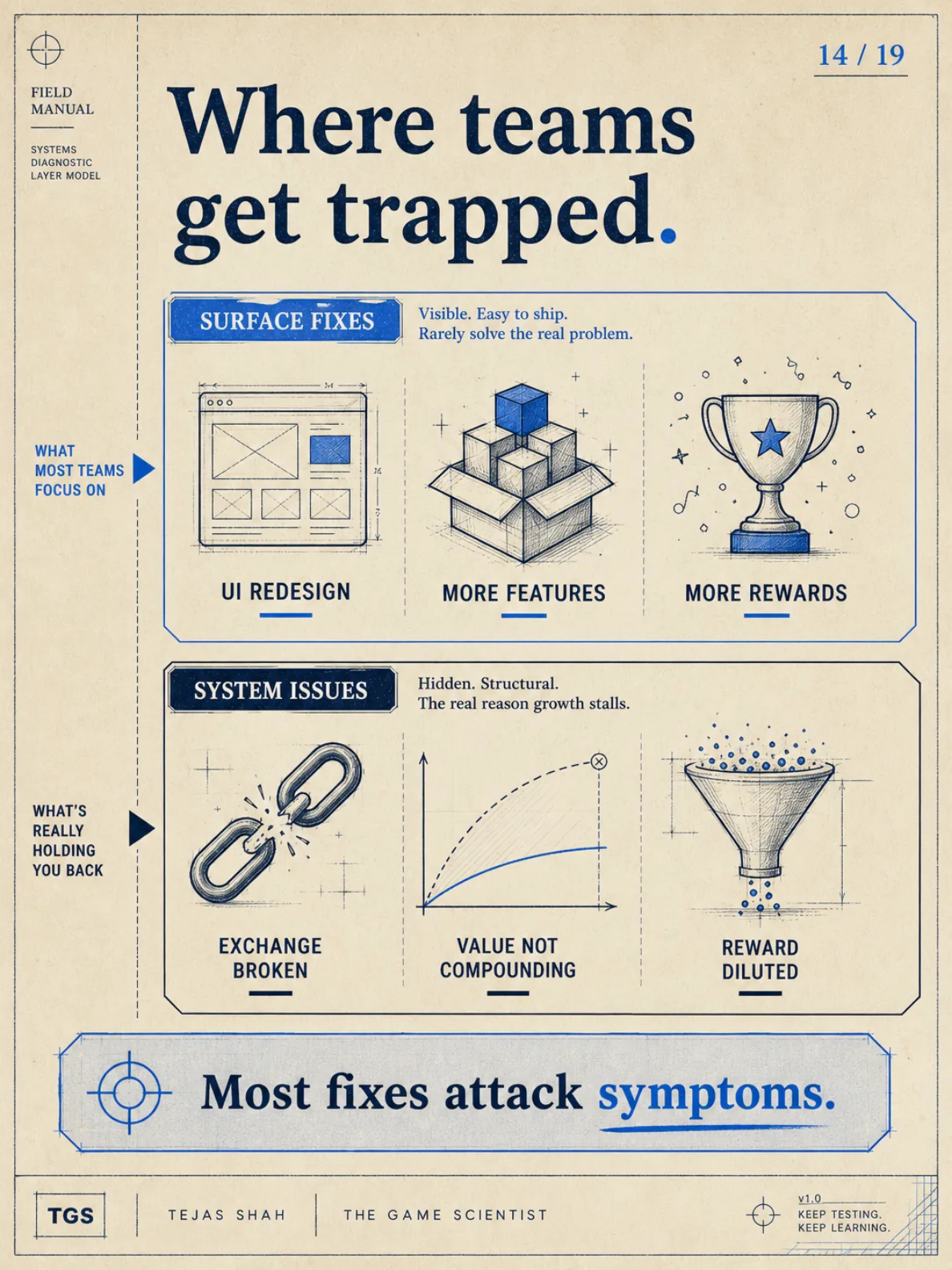
This is the pattern: teams redesign the interface when the exchange rate is broken. They add features when value is not compounding. They push harder onboarding when the user cost is already too high.
These are surface fixes. They are visible. They are easy to ship. And they rarely solve the real problem.
What is actually holding retention back is almost always one of three system-level issues: the exchange is broken (users spend more than they receive), value is not compounding (the product does not get more valuable the longer you use it), or the reward is diluted (what used to signal progress now creates noise). Each of these requires a different fix. None of them shows up clearly in a UI redesign, a feature addition, or a new reward system layered on top of a depleted one.
The Monetization Audit I run often starts here — not at the pricing mechanics or the paywall design, but at the underlying exchange rates that determine whether users feel the product is earning their spend or quietly draining it.
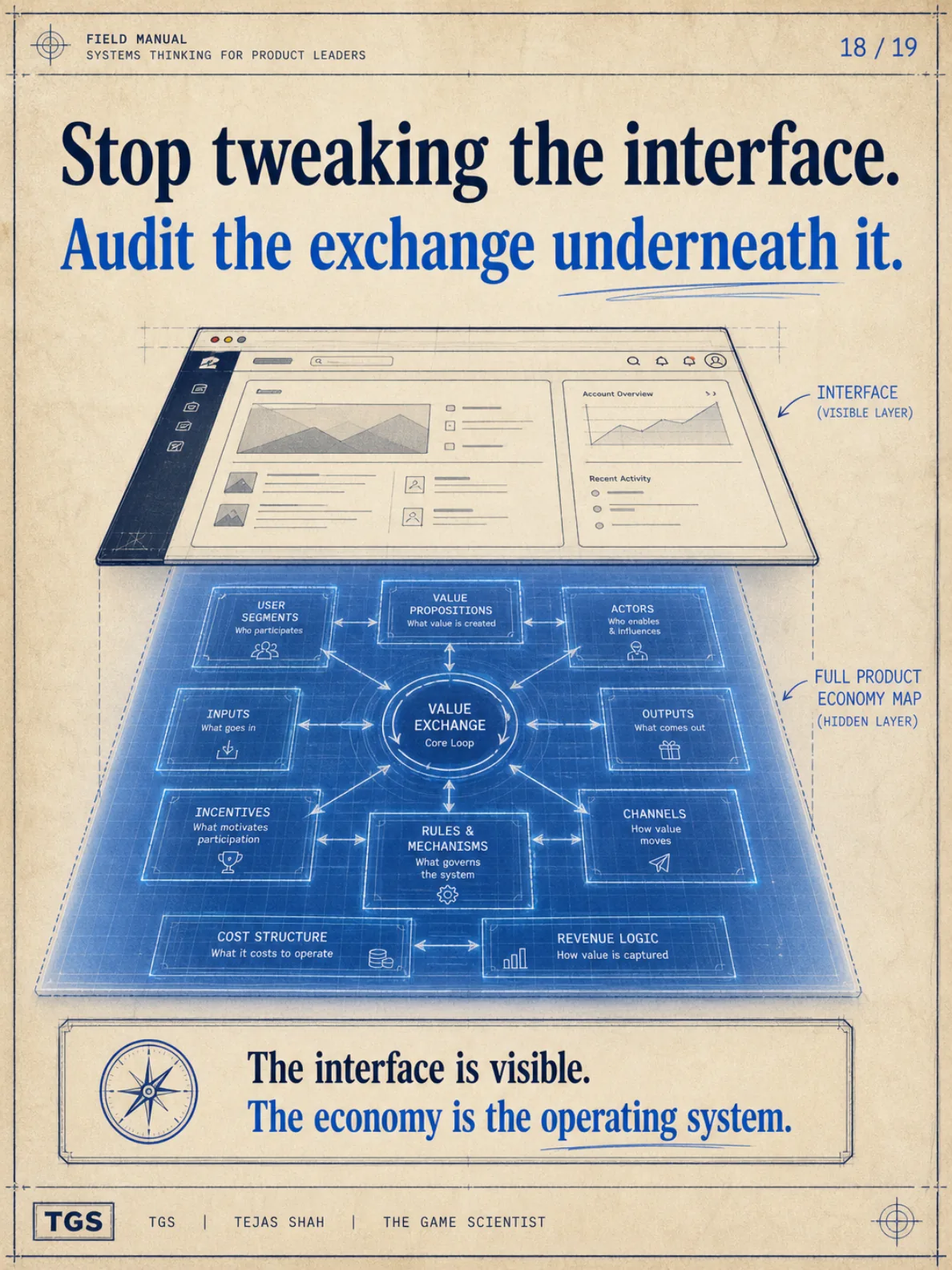
Stop tweaking the interface. Audit the exchange underneath it.
The interface is visible. The economy is the operating system. If you do not design your product economy on purpose, your users will still live inside it. They will just experience a broken one.